
In my first article, we talked about the fact that men don’t read much fiction anymore. This isn’t a recent problem, but it is growing, and it all starts—like so much dysfunction in our lives—in middle school. That’s where the reading habits of boys and girls really diverge.
Up until about age 11 or 12 (roughly 6th grade in North America), there is a sudden drop in boys’ reading for pleasure, while girls continue to read stories for pleasure at roughly the same rates. Numbers from the NEA, the Department of Education, and the National Library Association all paint the exact same picture.
Once boys stop reading fiction or reading for pleasure at all, they rarely come back. Next time, we’ll talk about the market forces behind that. But for now, let’s look at what the heck happens around that time that drives boys away.
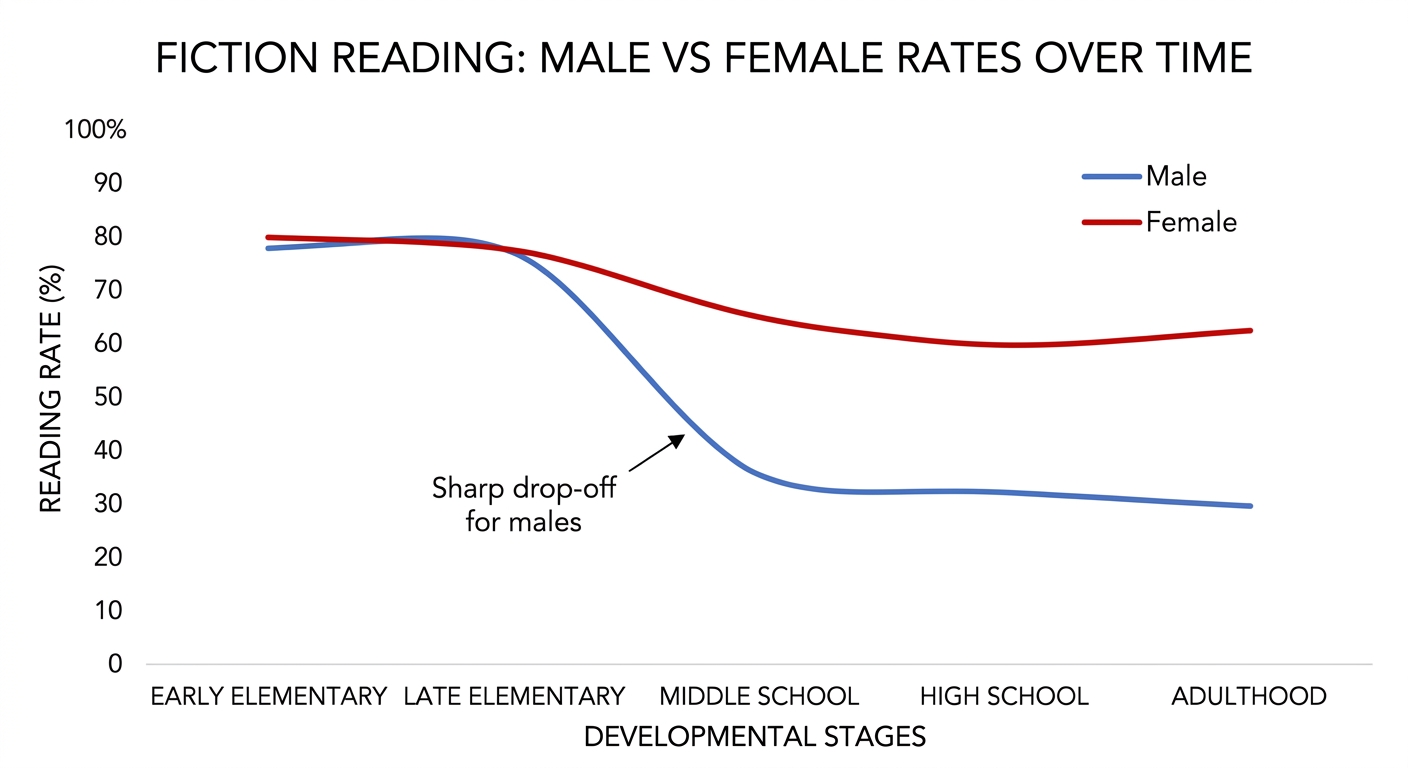
Educators and researchers point to basically four main reasons for this “middle grade cliff.” We aren’t looking for scapegoats—there are a lot of moving parts here—but we have to identify the problem before we can fix it.
Boys stop reading (books in general, but fiction specifically) because of:
- Social pressure: Reading is for girls and nerds. This is hardly new; I got my ass kicked back in the 1960s for reading and “making others look stupid.” (Actual quote. Gotta love small towns.) But the social coding has only gotten sharper. Oprah, Reese and even Taylor Swift have their book clubs, and millions follow. Where are the cool guys who read in our world? (Besides me, but you know, who the hell am I?)
- Developmental and attention divergence: The brains of boys and girls are developing differently at that age. Girls, in general, tend to hit certain verbal milestones earlier and have longer attention spans for static, seated tasks. Silent reading in school has all but disappeared, but what remains feels like endless boredom to most 11- and 12-year-old boys, especially if they didn’t choose the book to start with. Broccoli might be good for you, but nobody CHOOSES broccoli.
- The content desert—a lack of male-centric material: If you look at how reading lists in schools have changed (sometimes for perfectly valid reasons), you’ll find that the stories chosen either stick rigidly to the “Canon” of dry classics or lean heavily toward contemporary, female-centric emotional dramas. Right or wrong, try getting your teenage son to read Brontë. Good luck to you. At the same time, short stories have vanished from curricula, missing a crucial format for developing attention spans.
- Competition from video games, streaming, and social media: It’s simple. Boys want action and agency. This isn’t about blaming video games; it’s about what they provide young male brains: the thrill of adventure, active problem-solving, and immediate feedback loops. This can happen through books–at least if it’s taught properly–but modern gaming and manga/anime deliver that exact hit in a way that traditional middle-grade fiction stopped doing. Boys read manga and graphic novels at much higher levels than “real books” for a reason.
I know what my “gateway drugs,” to reading were.
When I was growing up, I had parents who not only supported my reading habit but insisted on it. “I don’t care what you read, as long as it isn’t dirty. Read the back of the cereal box, just so long as you read,” was my mother’s mantra.
Trips to the library and to Mrs. Malinsky’s used book store were almost weekly events. Classic Illustrated comics turned me on to “real” stories aimed at the teenage male brain (Treasure Island, Frankenstein, The Three Musketeers, Ivanhoe) without feeling like work. Anthologies of short horror and mystery meant I could pick up a book, read a chunk, and put it down while I was still having fun. And while the novelizations of popular movies might have had terrible writing and hardly qualify as literature, because I knew the story already I could read the book and visualize the world. Then i found out some of those movies were based on “real books,” and down the rabbit hole I went.

As I got older, my father read action and spy thrillers, and he got me reading them. They were cool because Dad did it. (Yes, that influence shifts over time, but enjoy it while it lasts, parents.) Shout out to Mack Bolan, Remo Williams and the rest of those cheap paperbacks they used to sell from a spinning rack in the corner store. That led to more advanced thrillers like Ludlum and Clancy, which in turn dragged me down the rabbit hole to the heavy stuff like Tolstoy and Dostoyevsky.
The answers to this breakdown basically fall into two categories:
- How we design school curricula to meet boys’ needs without leaving anyone else out. We need a hard look at reading pedagogy.
- Having enough good material available, which is a publishing market problem. That’s our next article.
What do you think? Am I onto something, or do you have a counter-argument? Let’s hear it in the comments.
Meanwhile, if you have a book club, men’s group, or library event where you’d like a talk on getting boys to read more, drop me a line. I do them over Zoom or in person (within a drive of Las Vegas). You can reach me at wayne@wayneturmel.com or 630-347-8369.
Hey, Want a FREE EBOOK? Join my newsletter list and you’ll receive a 40 page collection of stories set in the world of boxing. Going Rounds is available. If you’re already a subscriber, click here to download.