One of the best things about being in contact with other winners and finalists of the American Book Fest awards, is finding out about the time periods and topics that have obsessed their authors. That brings us to an author and topic I’ve never heard of: Kate Beales and her tale of the British colony in Patagonia, Broken Horses.
Okay Kate, floor’s yours. What should we know about you?
I’m from the UK, and I live mostly in London with my husband and two grown-up sons. I say mostly, because I spend as much time as I can in the hills of Northern Piemonte, Italy, where I host creative retreats for writers and other artists.
My background is in theatre – I learned my trade as an assistant director at the beautiful Deutsches Schauspielhaus in Hamburg, where, because I spoke English, I got to work with all the international directors. Over the next five years, I toured the world with the English Shakespeare Company, became a theatre director and then joined the Learning Department at the National Theatre as a freelance associate. I’ve created projects for and with children, young people, elders, teenagers at risk of homelessness, business people and many other communities. I’ve made a show with (yes, with!) toddlers, set in a giant bed, and worked with refugees on the streets of Paris and Athens. I’ve collaborated with an analogue photographer to create pop up darkrooms and pinhole cameras for community storytelling, and worked with puppeteers in the townships of South Africa. Along the way, I’ve learned to tell stories and teach storytelling – including for the Tisch School of the Arts at NYU, where I worked as a visiting professor teaching both Storytelling and Shakespeare for twenty years. Today I facilitate work with limbless and wounded veterans, teaching writing and theatre, helping them share their stories of resilience.
I write my own stories whenever I can, in between the day job, mostly on trains and buses. I’m proud of Broken Horses, it’s had a long and rocky path to publication, and I’m delighted that it’s made it out into the world. I’ve been told, by someone who has lived experience of the story behind the story, that it ‘digs up the bodies’ – in a good way!
This is a story I know most people have no exposure to. What’s the book about?
Broken Horses is the story of Georgie, a young Englishwoman who travels to Southern Patagonia after the Great War, hoping to begin a new life as governess to a motherless child. Slowly, she builds a friendship with her employer, the widower Ian Creed, and dares to dream of a secure future as his wife. At the same time, her heart is drawn to Raúl, the gentle horsebreaker, who teaches her to love her wild new home.
But Patagonia is in turmoil, riven with political struggle. Ian, suffering from the loss of his wife and his own wartime trauma, becomes increasingly erratic. When a rural workers’ strike leads to rebellion and the region’s colonial landlords plan brutal reprisals, Georgie finds herself caught between the values of her old world and the desperation of the new.
What are the roots of the story? What is it about this time period you find so fascinating?
I’ve always been interested in how Europe responded to the collective trauma of the first world war – and how the role of women changed at that time. The conflict really was global: colonial Patagonia was affected too, even though it’s so far away from the rest of the world.
The roots of this story lie in my curiosity about how it might have felt for a European woman to sail across the world to make a life in such a far-off and inhospitable place. My own grandmother sailed to Punta Arenas in 1905: it must have been unimaginably hard. The more research I did,, the more I was fascinated by Patagonia’s history. The indigenous people who had roamed the land for millennia were systematically destroyed by the new settlers. The environment was irrevocably altered, the migrant workers brutally exploited. And yet it’s a beautiful, haunting world, full of stories of courage, hope and heroism as well as violence and loss.
For more insights into why I wrote this book, please check out this 7-minute documentary about the story behind Broken Horses. https://vimeo.com/djangopinter/brokenhorses
What’s your favorite scene in the book?
This is a really difficult question! There is a scene set at the height the workers’ rebellion that I’m particularly proud of because it cost me a lot to write it. I still find it difficult to read back. There are a couple of moments which were validated by subsequent experiences in Patagonia that pretty much exactly replicated what I’d written – that felt wonderful! The scene where the gosling is attacked by the carancho actually happened. I witnessed it in Magellanes, Chile and understood at the time that it was something very special. I’m very happy that it made it into the book. I am also very happy with the twist at the end: it took me at least six different versions to get the ending the way I wanted it!
If pressed to choose, I would probably go for the scene where Georgie rides out onto the plain with Raúl and they encounter a herd of wild horses. The experience lifts Georgie out of the trauma she’s been living with, and gives her a glimpse of freedom – it also cements her relationship with Raúl, although neither of them know it yet.
Thanks for your time and your fascinating tale. Where can we learn more about you?
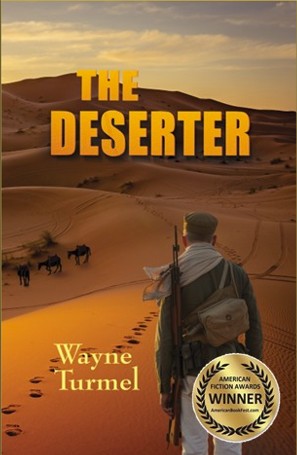
Check out The Deserter- a Tale of the Foreign Legion. “Wayne Turmel’s The Deserter manages to feel both old fashioned and strikingly original. While it possesses qualities of the adventure tales of old—whether that be those of daring from Scott and Cooper or stoical Hemingwayesque figures or most directly P.C. Wren of Beau Geste fame with even a bit of T.E. Lawrence. “– Michael Harnett, author, Windmill Bluff