By now, it’s abundantly clear from Acre’s Bastard that I have a complicated relationship with organized religion. Still, any student of history knows that little else has moved the levers of power in every corner of the world like faith and people’s reactions to it. Case in point: CLR Peterson’s new novel about the Renaissance, the Reformation and the line between conscience and heresy. “Lucia’s Renaissance” comes from the author’s own academic interest in the topic. Here’s what she has to say:
What’s your deal?

Renaissance history came to life for me during a semester of study in Italy. Then Martin Luther’s bold stand against the Roman Church and its pleasure-loving Pope Leo, a classic David-versus-Goliath battle, hooked me on the Reformation. I’ve pursued my passion for the Renaissance/Reformation era ever since, earning a PhD in Early Modern European History at Stanford University. Research for my debut novel, Lucia’s Renaissance, included reading heresy trial transcripts in Venice’s State Archives.
Geeky but cool. What’s Lucia’s Renaissance about?
Heresy is fatal in late sixteenth-century Italy, so only a suicidal zealot would so much as whisper the name of Martin Luther. But after Luther’s ideas ignite a young girl’s faith, she can’t set them aside, even when faced by plague, death, and the Inquisition.
What is it about that time period that is so fascinating to you?
For years, I’ve been intrigued by the relationship between the Italian 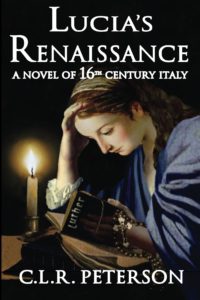 Renaissance, with its vitality, creativity, and focus on humanity, and the religious Reformation sparked by Luther.
While reading heresy trial records from this era, I found a microcosm of this Renaissance/Reformation tension. A bare-bones portrait emerged of a Renaissance-educated Italian physician so devoted to Martin Luther’s ideas that for years he smuggled the reformer’s writings into Italian lands, leading to three trials before the Roman Church’s Inquisition. My novel fills out his family’s story (using literary license when necessary) from the viewpoint of the physician’s daughter, Lucia.
What’s your favorite scene or event in the book?
When Lucia unlocks a hidden drawer in her father’s desk, she makes a shocking discovery: a book by Martin Luther, the arch-heretic her priest railed against. Questions flood her mind. Why was the book placed in the drawer? Does her father, a strict follower of the Church’s rules, know about the book? Could he be a heretic?
Lucia must decide whether to report her find to the priest, lock the book away and pretend she never saw it, confront her father, or read the book and make her own judgment.
Where can people learn more about you and Lucia’s Renaissance?
My website: clrpeterson.com
My book’s Amazon link: https://www.amazon.com/dp/ B076GKJY2V
My book’s Goodreads link: https://www.goodreads.com/ book/show/36339179-lucia-s- renaissance?from_search=true
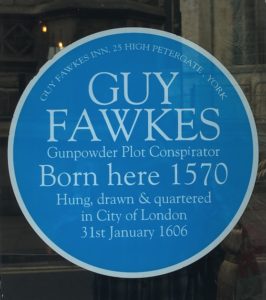 November night and as we came low over England, small towns were blasting fireworks, so there were little starbursts all over the ground. Those demonstrations, of course, were in memory of Guy Fawkes and the Gunpowder Plot. As this plaque shows, it failed and the consequences weren’t great for Guy. But the story lives on. One author has asked the question: what if the plot to blow up Parliament had succeeded? The answer is a pair of novels: “
 Tony Morgan lives in Yorkshire in the UK, close to the birthplace of Guy Fawkes. His books have been described as a perfect read for lovers of the works of C.J. Sansom and S. J. Parris and anyone interested in how historic events have shaped our own times. Profits from both his books in 2017 are being donated to York Teaching Hospital Charity’s dementia appeal.
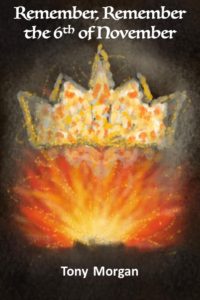 of Guy Fawkes and the Gunpowder Plot. It’s a pivotal moment in British history, celebrated annually on November 5th with bonfires and fireworks. Given few people know the details behind this, I’ve focused on the real-life events but couldn’t stop myself from including a few twists along the way.
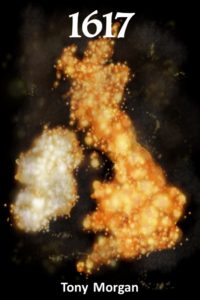 The first book is set in a world with fascinating, if alarming, parallels with modern times – terrorists on the streets of London, religious unrest, government surveillance and conflict with Europe. The history of the Gunpowder Plot is compelling, from the motivations of the Catholic conspirators, to the intrigue, betrayals, torture and so on.
 I am a fifth-generation Colorado native – and because I was the geeky kid who kept pestering the “old people” with questions, from an early age I was filled with a wealth of strange and historical stories. I’m from Golden originally, and now live in Denver. My undergrad degree is in History and I love the more unusual facets of history. In my free time, if I’m not writing, I’m off combing the mountains for old historical relics and enjoy traveling around the world. I am a member of Lighthouse Writers, Colorado Author’s League, Historical Novel Society and History Writers of America along with Women Writing the West.

 When not spending time with his family, teaching, playing hockey, and enjoying the outdoors, he continues to research and write. A series of new releases are planned for the future.
 love exploring how local history is intertwined with national events. And I have always been drawn to history of the American West. So, throughout my life, I have contemplated how my little corner of the world developed over time. My family has some property in the Greenhorn Mountains of Kern County. The area witnessed its own gold rush in 1853 and 1854.
 I can’t think the members of NWG enough for their support, love and assistance with my writing–not to mention just getting me out of the house and out amongst humans once a week.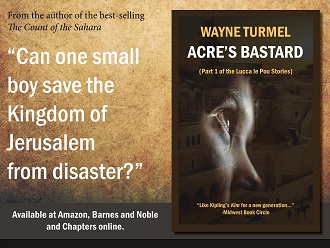
 Writer, mad cake lady, re-enactor, historian.
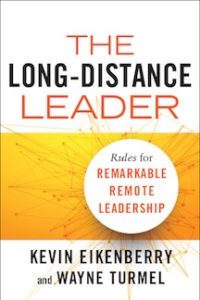 available for pre-order. It’s from Berrett-Koehler publishers, and we couldn’t be happier, both with the book and our partnership with B-K.
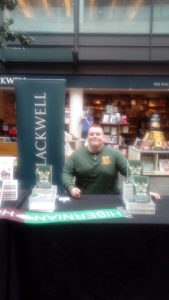 Ian Colquhoun is an author and historian from Livingston, Scotland. Since 2007 he has released 11 books, with subjects ranging from military history to football. He is a keen military historian and Hibernian FC fan. Ian’s life changed in 2002 when, at the age of 24, he was the victim of assault and arson which saw him lose both legs. No longer able to do his old warehousing job, he went to university to study history and then went on to writing. For a time he was also an amputee actor/stunt man (okay, I now feel completely useless and out of excuses for pretty much anything!), and has appeared in movies like The King’s Speech and Sunshine on Leith, as well as in TV series such as Taggart and Downton Abbey. Largely retired now for medical reasons, Ian still writes for a newspaper called The Irish Voice, mostly covering sports.